Beyond the Bottle: What Dermatologists and Chemists Really Think About Premium Skincare Ingredients
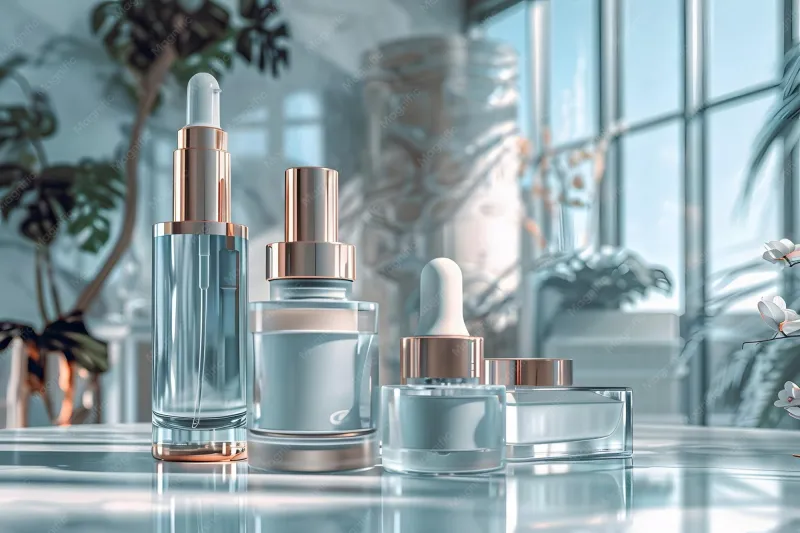
Photo: luxury skincare serum bottles laboratory science elegant flat lay, via img.freepik.com
The Promise Behind the Price Tag
Walk through the beauty floor of any Neiman Marcus or Saks Fifth Avenue, and you will encounter an almost overwhelming constellation of serums, creams, and elixirs, each one promising to restore luminosity, reverse time, or fundamentally reimagine the texture of your skin. The packaging is exquisite. The sales associates are impeccably informed. And the price points—ranging from $80 to well over $500 per product—signal that something extraordinary lies within.
But what, precisely, are you purchasing when you invest in a luxury skincare formulation? Is the premium justified by genuine scientific advancement, or are consumers simply paying for prestige and presentation? To answer these questions with the rigor they deserve, Glisten Beauty consulted board-certified dermatologists and independent cosmetic chemists whose work exists well outside the influence of brand marketing budgets.
The answer, as it turns out, is nuanced—and far more illuminating than a simple yes or no.
Retinol: The Ingredient That Earned Its Reputation
Few ingredients in the history of modern cosmetics have accumulated a body of clinical evidence as robust as retinol. A derivative of Vitamin A, retinol has been the subject of peer-reviewed research for decades, and the consensus among dermatologists is remarkably consistent: it works.
"Retinol remains one of the most clinically validated topical ingredients we have," explains one New York-based board-certified dermatologist who advises several luxury skincare brands. "It accelerates cellular turnover, stimulates collagen synthesis, and demonstrably reduces the appearance of fine lines and hyperpigmentation over sustained use. The evidence is not ambiguous."
Where the distinction between mass-market and luxury formulations becomes genuinely meaningful is in delivery technology. Retinol is notoriously unstable—it degrades rapidly when exposed to light and air, and its efficacy is directly tied to how well a formulation protects and delivers it to the deeper layers of the epidermis. Premium brands invest heavily in encapsulation technologies, microemulsion systems, and airless packaging that preserve retinol's potency in ways that lower-cost competitors frequently cannot replicate.
"A $20 retinol cream and a $200 retinol serum may list the same active ingredient," notes a cosmetic chemist with over fifteen years of formulation experience. "But if the cheaper product has degraded by the time it reaches your skin, you are essentially applying an inert substance. The delivery architecture matters enormously."
For consumers committed to retinol's benefits, the guidance is to introduce it gradually—beginning with lower concentrations two to three evenings per week—and to pair it consistently with broad-spectrum SPF during daylight hours.
Hyaluronic Acid: Hydration With Meaningful Depth
Hyaluronic acid has become something of a cultural phenomenon in American skincare, appearing in formulations at virtually every price point. Its fundamental mechanism is well understood: it is a humectant capable of binding up to one thousand times its weight in water, drawing moisture into the skin and plumping the appearance of fine lines in the process.
However, the molecular weight of hyaluronic acid determines precisely where in the skin it operates—and this is where premium formulations demonstrate their sophistication. High-molecular-weight hyaluronic acid creates a visible, immediate plumping effect at the surface. Low-molecular-weight variants penetrate more deeply into the dermis, delivering hydration at a structural level. The most advanced luxury formulations layer multiple molecular weights simultaneously, addressing both surface radiance and deeper dermal density.
"The multi-weight approach is where you begin to see a real clinical difference," says a dermatologist specializing in cosmetic procedures at a prominent Beverly Hills practice. "A single-weight drugstore formula will give you surface hydration. A layered, high-concentration luxury serum is doing something meaningfully different for the architecture of the skin."
The ritual of application also matters. Hyaluronic acid serums should be applied to slightly damp skin to maximize their moisture-binding capacity, followed immediately by an occlusive moisturizer to seal hydration in place.
Peptides: The Sophisticated Communicators
Peptides represent one of the more intellectually fascinating frontiers in cosmetic chemistry. These short chains of amino acids function as biological messengers, signaling skin cells to perform specific restorative actions—producing more collagen, repairing barrier function, or moderating inflammatory responses.
The challenge with peptides is that their efficacy is highly dependent on formulation stability and skin penetration, two variables that luxury brands are uniquely positioned to address. "Peptides are fragile molecules," explains a cosmetic chemist who has worked with several European luxury houses. "They can be inactivated by other ingredients in a formula, degraded by improper pH levels, or simply fail to penetrate the skin barrier if the delivery vehicle is not engineered correctly. When a luxury brand invests in peptide technology, a significant portion of that investment is ensuring the peptide arrives at its biological target intact and active."
Neuropeptides, copper peptides, and signal peptides each address different aspects of skin aging, and the most sophisticated luxury regimens incorporate multiple peptide classes in a deliberate sequence. This is not marketing complexity for its own sake—it reflects a genuine understanding of how these molecules interact with skin biology.
What Consumers Should Realistically Expect
Perhaps the most important service that Glisten Beauty can offer its readers is a framework for calibrated expectations. Premium skincare ingredients, when properly formulated and consistently applied, deliver measurable improvements in skin texture, hydration, tone, and resilience. These improvements are real, clinically documented, and cumulative over time.
What they are not is instantaneous. Retinol's collagen-stimulating effects become visible over three to six months of consistent use. Peptide-driven improvements in skin density reveal themselves gradually, across a sustained regimen. Hyaluronic acid offers the most immediate visible results, but even its deeper structural benefits require ongoing commitment.
"The consumers who see the most dramatic transformations are the ones who approach luxury skincare as a long-term investment rather than a quick fix," observes a dermatologist based in Chicago. "They choose their products thoughtfully, they layer them correctly, and they are patient. The science supports their results."
Building an Investment-Worthy Regimen
For the discerning consumer ready to invest meaningfully in their skin's future, the evidence points toward a focused, layered approach. A well-formulated vitamin C serum in the morning addresses oxidative stress and brightness. A multi-weight hyaluronic acid serum applied to damp skin provides both immediate and lasting hydration. An encapsulated retinol used in the evening drives cellular renewal while you sleep. A targeted peptide treatment addresses specific concerns—whether fine lines, firmness, or barrier integrity.
The luxury is not merely in the experience of using these products, though that experience is undeniably part of their appeal. The luxury lies in the research investment, the formulation precision, and the delivery technology that ensures the active ingredients you are paying for actually reach the skin structures where they can make a meaningful difference.
At Glisten Beauty, we believe that radiance is not accidental. It is the result of informed choices, consistent practice, and a willingness to invest in formulations that honor the complexity of your skin's biology. The science, as it turns out, is genuinely on your side.