Access Without Arrival: Why the Democratization of Luxury Skincare Has Left So Many Feeling Dimmer Than Ever

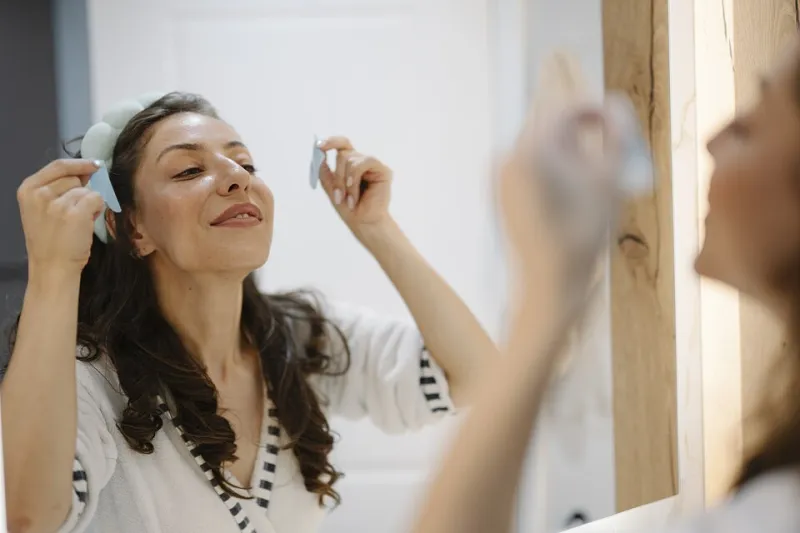
There is a particular kind of frustration reserved for those who have done everything right. The vitamin C serum applied with surgical precision each morning. The peptide-rich moisturizer sourced from a European apothecary. The retinol protocol observed with near-religious discipline. And yet, standing before the mirror on an ordinary Tuesday, the reflection offers something far less than luminous.
This experience—quiet, disorienting, and increasingly common—sits at the center of what beauty industry analysts are beginning to call the glow paradox. Luxury skincare has never been more accessible to the American consumer. Prestige formulas once confined to department store counters and dermatology offices now arrive at doorsteps via subscription boxes, specialty retailers, and direct-to-consumer brands offering clinical-grade actives at mid-range price points. By every commercial measure, the golden age of skincare has arrived. And yet, by the measure that matters most—how people actually feel about their skin—something has gone quietly wrong.
The Numbers Behind the Dissatisfaction
The data is not anecdotal. A 2023 consumer sentiment report from Mintel found that despite record spending on facial skincare in the United States, the proportion of adults who describe their skin as "glowing" or "radiant" has declined over the preceding five years. Separate research from the American Academy of Dermatology noted a marked increase in consultations driven not by specific skin conditions, but by a generalized sense that skin simply does not look the way patients expect it to.
These are consumers who are, by any historical standard, extraordinarily well-informed and well-equipped. They understand the difference between humectants and occlusives. They track their skin's response to niacinamide with the diligence of a clinical trial participant. And still, the radiance they seek remains elusive—or worse, feels perpetually just out of reach.
The question worth asking, then, is not what these consumers are missing from their routines. It is what the beauty industry, and the culture surrounding it, may have promised that no product could ever authentically deliver.
The Expectation Economy
Dr. Simone Hartwell, a board-certified dermatologist practicing in New York City, has observed this pattern with growing concern. "What I see in my practice is a population of patients who are technically doing the right things," she notes. "The products are often excellent. The issue is that the benchmark for 'radiant' has shifted dramatically, and it has shifted toward something that does not exist in nature."
The benchmark she references is, of course, the curated image—the filtered, lit, and retouched complexion that saturates social media feeds and brand campaigns alike. Even in an era of growing transparency around digital manipulation, the cumulative effect of daily exposure to idealized skin creates what psychologists term expectation inflation: a gradual, unconscious recalibration of what one's own skin ought to look like.
When the standard is perfection, improvement becomes invisible. A consumer whose hyperpigmentation has genuinely faded by thirty percent may still feel defeated because the comparison point is not her skin from six months ago—it is the luminous, pore-free complexion she encountered seventeen times before breakfast.
This psychological dimension is not a peripheral concern. It is, many experts argue, the central engine of the glow paradox.
The Ingredient Saturation Problem
Beyond perception, there is a physiological dimension to the dissatisfaction that deserves equal scrutiny. The democratization of luxury skincare has brought with it an unprecedented willingness among consumers to layer multiple high-potency actives—a practice that dermatologists are increasingly flagging as counterproductive.
"The skin's barrier has a threshold," explains Dr. Marcus Osei, a cosmetic chemist who consults for several prestige beauty brands. "When you are applying exfoliating acids, a retinoid, a high-concentration vitamin C, and a growth factor serum in the same routine, you are not compounding benefits. You are frequently creating inflammation that manifests as dullness, sensitivity, and compromised texture."
The irony is acute: the very commitment to luxury skincare that should yield radiance may, in excess, be actively suppressing it. The skin's natural luminosity depends on a functioning barrier, a balanced microbiome, and an inflammatory response that is not perpetually engaged. A complexion subjected to aggressive daily intervention may be too occupied with recovery to produce the glow its owner is so earnestly pursuing.
This is a conversation the industry has been slow to have with consumers, in part because restraint does not sell product. The language of luxury beauty is inherently additive—another serum, another step, another innovation. The idea that doing less might yield more runs against the commercial logic of an industry built on aspiration and acquisition.
What the Industry Isn't Saying
Insiders within the prestige beauty space are candid, if cautious, about this tension. A senior product developer at a well-regarded American skincare house, speaking on condition of anonymity, put it plainly: "We know that a significant portion of our customers are over-treating their skin. But the marketing imperative is to introduce new products, new benefits, new reasons to buy. The message 'use less' is not one that brand teams are incentivized to send."
This structural silence leaves the consumer in a peculiar position—awash in premium options, fluent in the language of ingredients, and yet increasingly unable to locate the radiance that all of this investment was meant to produce.
The beauty editors and facialists who work closest with real skin tell a consistent story: the most luminous complexions they encounter belong not to those with the most elaborate routines, but to those who have found a point of intelligent restraint. Hydration. Protection. Targeted treatment. Rest. These are not glamorous prescriptions, but they are honest ones.
Reclaiming Radiance on Your Own Terms
For the discerning consumer willing to step back from the noise, several reorientations are worth considering.
First, establish a true baseline. Photograph your skin in natural light—without filters, without makeup—and return to that image monthly. Progress measured against your own skin, rather than against an external ideal, is the only progress that is real.
Second, audit your routine for redundancy and potential conflict. A streamlined regimen of genuinely complementary products will almost always outperform a maximalist approach. Consult a dermatologist before adding any new active, particularly if your skin has felt reactive or lackluster.
Third, interrogate your relationship with comparison. The radiance visible on a screen is not a standard; it is a construction. The glow that belongs to you—the one that reflects your skin's actual health, your sleep, your hydration, your stress levels—is quieter and more nuanced. It is also more sustainable than any formula can manufacture.
The glow paradox will not be resolved by the next breakthrough ingredient or the next prestige launch. It will be resolved, for each individual who chooses to resolve it, by the willingness to measure radiance by a more honest and more personal standard.
At Glisten Beauty, we believe that luxury is not the accumulation of products. It is the clarity to understand what your skin truly needs—and the confidence to provide exactly that, nothing more.