Cold Season, Dimmer Skin: The Dermatological Truth Behind Winter Dullness and How to Reclaim Your Glow
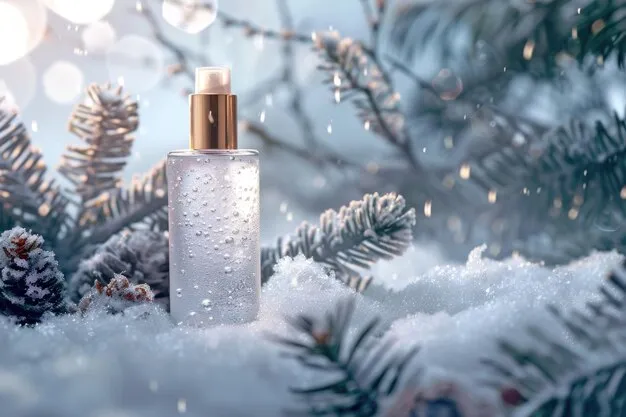
Photo: luxury skincare winter radiance serums moisturizer flatlay snow background, via img.freepik.com
There is a particular frustration that arrives alongside the first frost: the realization that your complexion, which may have carried a warm, sun-kissed vitality through the summer months, has quietly retreated into something flatter, less defined, and decidedly less radiant. This is not imagination, and it is certainly not vanity. It is biology — and understanding it is the foundation of any meaningful response.
The Biology of Seasonal Dullness
At the cellular level, skin luminosity is largely a function of how efficiently the epidermis renews itself. Keratinocytes — the primary cells of the outer skin layer — travel from the deepest layers of the epidermis to the surface in a process called cellular turnover. In healthy, warm-climate conditions, this cycle completes roughly every 28 days. During winter, however, that rhythm slows considerably.
Colder temperatures constrict blood vessels near the skin's surface, reducing microcirculation and, consequently, the delivery of oxygen and nutrients to epidermal cells. The result is a buildup of older, dehydrated cells that scatter light unevenly rather than reflecting it with the smooth consistency that reads as a healthy glow. Dermatologists frequently describe this phenomenon as "surface congestion" — a subtle but visually significant accumulation that no amount of highlighter can fully correct.
Compounding this is the dramatic shift in ambient humidity. Outdoor winter air carries far less moisture than summer air, and indoor heating systems further deplete what little remains. The skin's natural moisturizing factors — a complex of amino acids, urea, and lactic acid that maintain the integrity of the stratum corneum — become overwhelmed, leading to transepidermal water loss (TEWL) that visibly compromises plumpness and translucency.
The Role of Reduced UV Exposure
While dermatologists universally advocate for year-round sun protection, there is a nuanced conversation to be had about the role that controlled UV exposure plays in skin tone and radiance. Melanin production, which is stimulated by ultraviolet light, contributes to the warm, even pigmentation that many associate with a summery complexion. As daylight hours shorten and UV indices drop across much of the United States — particularly in northern states like Minnesota, Michigan, and New York — melanin synthesis decreases, and the skin can appear paler and less dimensional.
This is distinct from sun damage and should not be used as justification for unprotected sun exposure. Rather, it underscores how multifaceted the concept of radiance truly is, and why addressing winter dullness requires a similarly layered approach.
Exfoliation: The Non-Negotiable First Step
If sluggish cellular turnover is the primary villain of winter skin, then targeted exfoliation is its most effective counterpart. However, the type of exfoliation matters enormously during colder months, when the skin barrier is already compromised.
Harsh physical scrubs — those containing jagged particles or abrasive beads — can create micro-tears in a barrier that is already under stress. Dermatologists increasingly recommend chemical exfoliants, specifically alpha-hydroxy acids (AHAs) such as glycolic and lactic acid, as more precise and less disruptive alternatives. These compounds dissolve the bonds holding dead cells to the surface rather than physically abrading them away.
For those with sensitive winter skin, polyhydroxy acids (PHAs) offer an even gentler entry point. PHAs share the resurfacing properties of traditional AHAs but have a larger molecular structure that limits deep penetration, making them ideal for reactive or compromised complexions. Luxury formulations from brands such as Augustinus Bader and Vintner's Daughter have incorporated these compounds into sophisticated delivery systems that resurface while simultaneously reinforcing the skin barrier — a dual action that is particularly valuable during seasonal transitions.
Humectants, Emollients, and the Architecture of Hydration
Restoring luminosity in winter is not simply a matter of applying more moisturizer. It requires understanding the architecture of effective hydration — specifically, the distinction between humectants, emollients, and occlusives, and how they function in concert.
Humectants such as hyaluronic acid and glycerin draw moisture from the environment and deeper skin layers to the surface. In high-humidity environments, this works beautifully. In dry winter air, however, humectants can inadvertently pull moisture from the skin itself if not properly sealed. This is where emollients — ingredients like squalane, ceramides, and fatty acids — become essential. They fill the spaces between skin cells, restoring smoothness and flexibility to a surface that has become rough and light-scattering.
Occlusives, including petrolatum-derived ingredients and plant-based waxes, form a physical barrier that prevents moisture from escaping. The most refined luxury formulations layer all three categories into a single product, creating what cosmetic chemists refer to as a "moisture sandwich" — a term inelegant in its description but precise in its mechanism.
Targeted Treatments for Luminosity Restoration
Beyond foundational hydration, several active ingredients have earned clinical validation for their ability to restore skin radiance during winter months specifically.
Vitamin C remains one of the most thoroughly researched brightening agents available. As an antioxidant, it neutralizes free radicals generated by environmental stressors — including cold wind and indoor pollutants — while simultaneously inhibiting the enzyme responsible for excess melanin production. L-ascorbic acid, the purest form, is most effective but also most unstable; premium formulations address this through airless packaging and pH-optimized delivery systems.
Niacinamide, or vitamin B3, has experienced a well-deserved rise in dermatological esteem. Its ability to strengthen the skin barrier, reduce inflammation, and improve uneven tone makes it a particularly strategic winter ingredient. Unlike some actives, niacinamide is broadly compatible with other compounds and suitable for most skin types.
Retinoids accelerate cellular turnover directly, counteracting the slowdown that winter imposes at the biological level. However, they require careful introduction — particularly during a season when sensitivity is already elevated — and should always be paired with robust moisturization and diligent SPF use.
The Luxury Advantage: Formulation Precision Over Ingredient Lists
It is worth addressing a question that informed consumers frequently raise: does the price point of a luxury skincare product translate to measurably better outcomes, or does one pay primarily for packaging and prestige?
The honest answer is nuanced. The differentiator in genuinely premium formulations is rarely a single hero ingredient — many of which are now widely available across price points — but rather the precision of the surrounding formulation. Stabilization technology, delivery mechanisms, ingredient ratios, and the absence of potentially irritating fillers collectively determine how effectively an active compound reaches the skin and performs its intended function. In winter, when the barrier is compromised and sensitivity is heightened, this formulation intelligence is not a luxury — it is a clinical necessity.
Building a Winter Radiance Ritual
The most effective approach to seasonal dullness is systematic rather than reactive. A considered winter protocol might include a gentle, non-stripping cleanser that preserves the acid mantle, a chemical exfoliant used two to three times per week, a layered hydration regimen applied to damp skin, a targeted brightening serum, and a rich but non-comedogenic moisturizer sealed with a facial oil. Broad-spectrum SPF remains non-negotiable regardless of season.
Perhaps most importantly, the skin's needs in January are not the needs it had in July. Approaching winter with the same products and the same frequency that served you in summer is one of the most common — and most correctable — mistakes in seasonal skincare. Radiance is not a fixed state. It is a practice, refined with knowledge and sustained with intention.