The Quiet Glow: Why Dermatologists Are Urging Luxury Skincare Devotees to Put Down the Serum
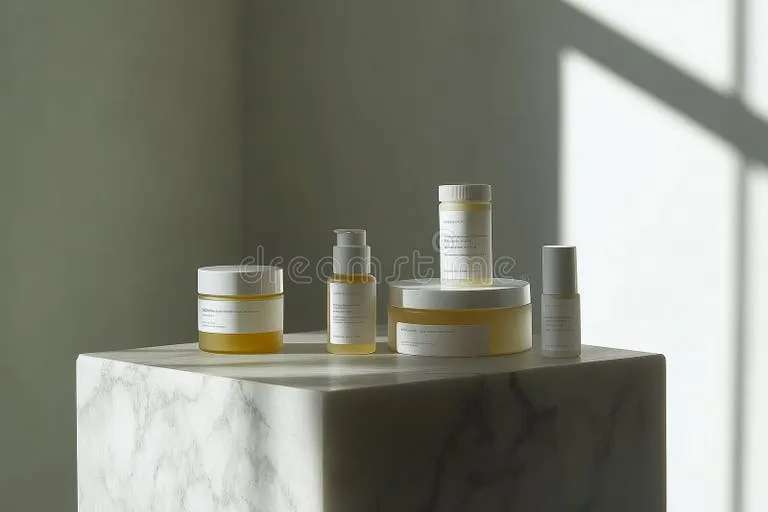
Photo: minimalist luxury skincare products arranged on marble surface with soft natural light, via thumbs.dreamstime.com
There is a particular kind of medicine cabinet that belongs almost exclusively to the luxury beauty consumer. Shelves lined with amber glass bottles, sleek obsidian tubes, and frosted jars bearing the names of Parisian laboratories and Korean biotech pioneers. Each product was acquired deliberately — researched, considered, and invested in at no small cost. And yet, despite the impeccable curation, the skin remains reactive, uneven, or stubbornly dull.
This is the paradox at the heart of modern prestige skincare: the very devotion that drives discerning consumers toward premium formulations can, when left unchecked, work directly against the radiance they are chasing.
When More Becomes the Enemy of Better
The concept of skin barrier integrity has moved steadily from clinical dermatology into mainstream beauty conversation over the past several years — and for good reason. The outermost layer of the skin, known as the stratum corneum, functions as the body's most sophisticated defense system. It regulates moisture retention, moderates inflammatory responses, and determines, in no small measure, whether the complexion reads as luminous or lackluster.
When that barrier is chronically disrupted — by over-exfoliation, competing actives, or the simple accumulation of too many potent ingredients — the skin enters a state of low-grade inflammation. Redness, sensitivity, breakouts, and a paradoxical loss of glow often follow. Dermatologists increasingly refer to this as "cosmetic overload," and it is, according to many practitioners, remarkably common among high-end skincare enthusiasts.
Dr. Whitney Bowe, a board-certified dermatologist based in New York whose work centers on the gut-skin axis and barrier health, has spoken extensively about the phenomenon. Her clinical observation aligns with what many of her peers are witnessing: patients who spend the most on skincare are not always the patients whose skin is thriving. The issue is rarely the quality of the products themselves. It is the compounding effect of using too many of them simultaneously.
The Accumulation Mindset and Its Origins
Understanding why over-treating occurs requires an honest examination of the cultural and commercial forces that shape luxury beauty consumption. The prestige skincare market is, by design, aspirational. Launches are events. Limited editions create urgency. The language of innovation — peptide complexes, bio-fermented actives, patented delivery systems — implies that each new product offers something the last one could not.
For the engaged beauty consumer, the logical conclusion of this ecosystem is accumulation. If retinol is effective, adding a vitamin C serum, a niacinamide concentrate, an AHA toner, and a resurfacing mask to the same routine feels like an amplification of that efficacy. In practice, it often produces the opposite.
Many of these ingredients interact in ways that are counterproductive. Vitamin C and niacinamide, once thought to be incompatible (a claim that has since been nuanced by further research), are merely one example of the complexity involved. More significantly, layering multiple exfoliating actives — a practice that has become almost normalized in enthusiast circles — systematically weakens the very barrier that makes radiance possible.
The Minimalist Dermatologist and the Refined Routine
A quieter, more deliberate school of thought has been gaining momentum within both clinical dermatology and the luxury brand landscape itself. Its central premise is elegant in its simplicity: identify what your skin genuinely requires, deploy the fewest possible high-quality interventions to address those needs, and allow the skin's own regenerative capacity to do the rest.
This philosophy does not advocate for abandoning investment in premium formulations. Quite the contrary. It argues that a single, superbly formulated moisturizer containing ceramides, cholesterol, and fatty acids in physiologically appropriate ratios will do more for long-term luminosity than a six-step regimen assembled without biochemical coherence. The emphasis shifts from quantity to precision.
Several heritage luxury houses appear to have absorbed this logic. La Mer's foundational Crème de la Mer, for all its near-mythological status, is fundamentally a barrier-supportive moisturizer — a single, considered product built around a proprietary ferment. Augustinus Bader's The Cream, one of the most discussed prestige moisturizers of the past decade, similarly centers its formulation on a patented growth factor complex designed to support the skin's intrinsic renewal mechanisms rather than override them.
A Framework for the Refined Edit
For those prepared to interrogate their current routines with genuine rigor, a structured approach to reduction is both practical and illuminating.
Begin with a reset period. Stripping the routine back to a gentle cleanser, a barrier-focused moisturizer, and a broad-spectrum SPF for two to four weeks allows the skin to stabilize. Improvements in texture, tone, and overall luminosity during this period are frequently dramatic — and instructive.
Reintroduce with intention. Rather than restoring the full prior routine, consider each product individually. What specific concern does it address? Is there clinical evidence for its efficacy? Does it contain actives that conflict with others in the rotation? If a product cannot answer these questions clearly, its place in a refined regimen is questionable.
Invest in fewer, better. The luxury beauty consumer is uniquely positioned to apply this principle with conviction. Rather than diversifying spend across a dozen mid-tier products, concentrating investment in two or three genuinely exceptional formulations — selected for their ingredient quality, their clinical backing, and their compatibility with one another — represents both a financial and a dermatological upgrade.
Prioritize the unsexy fundamentals. Consistent SPF application, adequate hydration, and a barrier-supportive nighttime moisturizer will outperform the most sophisticated active serum if the skin's foundation is compromised. Radiance is, at its most essential, a reflection of skin health — and health is built through consistency, not complexity.
Restraint as the Ultimate Luxury
There is something quietly radical about the minimalist approach in a market that profits handsomely from the opposite impulse. And yet it aligns, perhaps more honestly than any overcrowded routine could, with what Glisten Beauty has always understood about genuine radiance: that it is not manufactured through accumulation, but revealed through care.
The most luminous skin is not the most treated skin. It is the most respected skin — tended to with knowledge, restraint, and a willingness to trust the body's own remarkable capacity for renewal. In a culture that consistently conflates more with better, choosing less is not a compromise. It is, in every sense, the most refined decision a beauty consumer can make.